In grade 6, students are expected to understand how to find the area of triangles, parallelograms and trapezoids.
Over the span of three hours, we worked on 1. parallelograms, 2. triangles, and finally 3. trapezoids.
For paralleolgrams, students worked together to find a solution to the question – what is the formula of a parallelogram? One student worked through their answer via whiteboard, another used a physical object to make sense of his thinking.
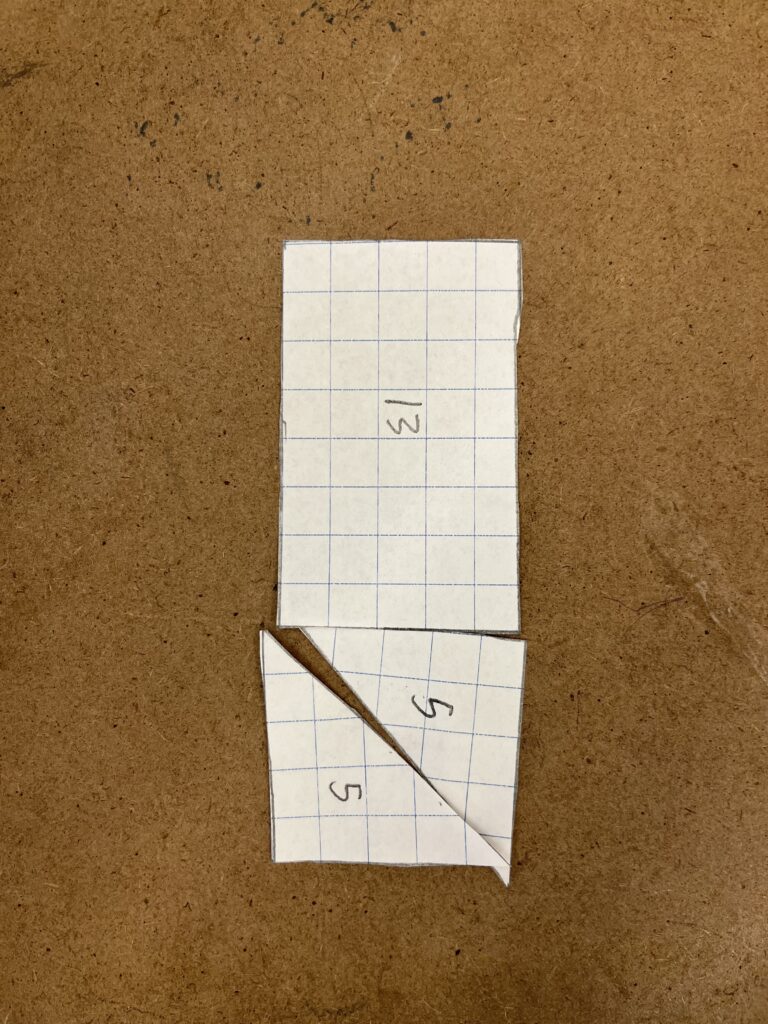
This activity allowed students to have autonomy over their learning, and they were able to discuss in a group how they determined their answers – peer/student-led learning!
For triangles, a similar layout was used, beginning with formula derivation and practice. One student immediately recognized that you could take a rectangle and cut it in half to create a triangle. This was so amazing to see the instant click for the students and allowed for student leadership and pride in their learning!

Trapezoids were proven a little harder – we discussed how trapezoids and rectangles were related, however, I learned that averages were an integral part of my understanding of the formula and that was a piece of information I took for granted. This made me reevaluate how to explain and teach the process of derivation.
My biggest take-away from these lessons were to give myself and students more patience and time as so many of the things that I know are not implicit knowledge but taught to me, which is how that knowledge becomes known – interesting!
Core Competency: Critical Thinking
Facet: Students engage with others in ways that build and sustain trusting relationships and contribute to collective approaches.
Profile: I express my ideas and help others feel comfortable to share theirs so that all voices are included.
First Peoples Principles of Learning: Learning takes patience and time.
Big Idea:
- Properties of objects and shapes can be described, measured, and compared using volume, area, perimeter, and angles (6)
Curricular Competency:
- Develop, demonstrate, and apply mathematical understanding through play, inquiry, and problem solving (6)
Content:
- area of triangles, parallelograms, and trapezoids (6)