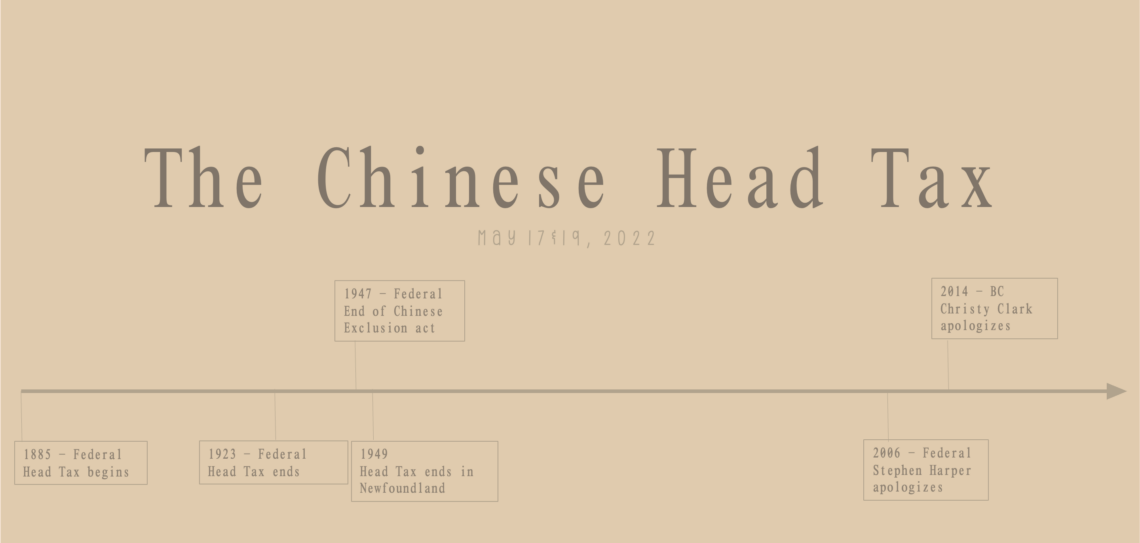
This was a set of linked lessons, that involved student collaboration, a KWL chart, solo work, as well as demonstrating student learning from past years and other projects.
Day 1: May 17th
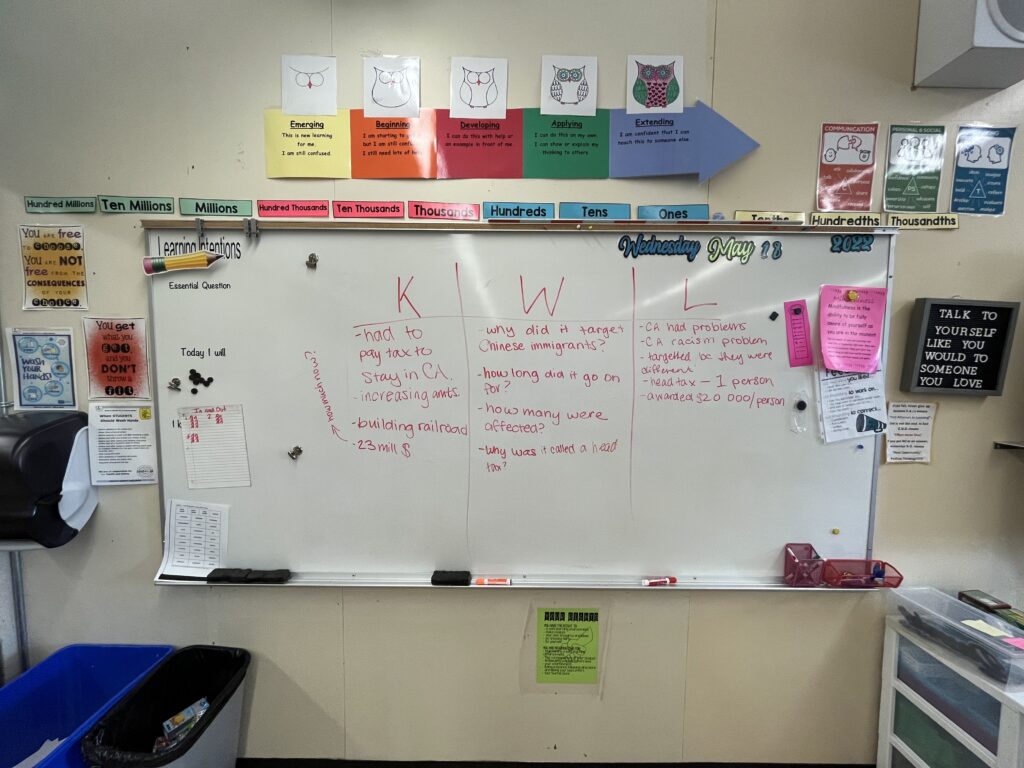
We started this topic with a KWL chart. Students knew a lot more that what was just written down (as it is shortened to fit on the board). Some students are in the midst of researching the Head Tax in their Learning Commons, and retained some very thoughtful knowledge, including knowing that the amount that Chinese immigrants had to pay increased over time from $50 to $500 over the 38 years.
The students had questions that were both surface level – easy to find answers in our reading, as well as deeper questions that involved nuance and opinion (such as why did it target Chinese immigrants?).
The learning was important to see, it both answered questions that we had discusses as well as encouraged further questions.
Day 2: May 19th
Students worked in groups to determine factors that caused many Chinese immigrants to come to Canada, both push and pull factors (such as poverty in China, or work available in Canada).
They discussed topics such as racism, the issue of discrimination, and the two major waves of immigration into Canada. Students recognized the importance of these discussions and drew important connections between the past events such as the Chinese Head Tax and current discriminatory practices in Canada and North America as a whole.
The topic of racism, past and present discriminatory events are continued to be discussed in this class through the lens of Residential Schools and Japanese Internment Camps.
Core Competencies: Reflective Thinking
Facet: Students learn to engage in inquiry when they identify and investigate questions, challenges, key issues, or problematic situations in their studies, lives, and communities and in the media.
Profile: I can gather and combine new evidence with what I already know to develop reasoned conclusions, judgments, or plans.
First Peoples Principles of Learning: Learning is embedded in memory, history, and story.
Big Ideas:
- Canada’s policies and treatment of minority peoples have negative and positive legacies. (5)
Curricular Competency:
- use social studies inquiry processes and skills to ask questions, interpret and analyze ideas; communicate findings and decisions (5)
Content:
- past discriminatory government policies and actions, such as the Chinese Head Tax, the Komagata Maru, residential schools and internment camps. (5)