This project was cross-curricular with both ELA and Fine Arts, the focus being on the math. This project came from the MathUP 5 book – and it was the first time trying it!
We read the book “The Patchwork Path: A Quilt Map to Freedom” by Bettye Stroud which focuses on a young girl and her father finding their way to freedom from slavery in the United States. They escape to freedom by using a patchwork quilt that the girl’s mother had created with clues and hints in the fabric, where they should turn, who they should befriend, and where they were going. The purpose of the book was to introduce students to the idea of quilts, scrap fabric being pulled together to create something beautiful.
Once the book was finished, we talked about different types of angles, parallel lines, types of triangles, symmetry, etc. Students had to find two of these ideas to focus on and include in their own quilt square (if there was more time, we would have found a way to create a class quilt, maybe something I can try when I am a certified teacher).
Here is a student’s quilt example – not cut out yet:
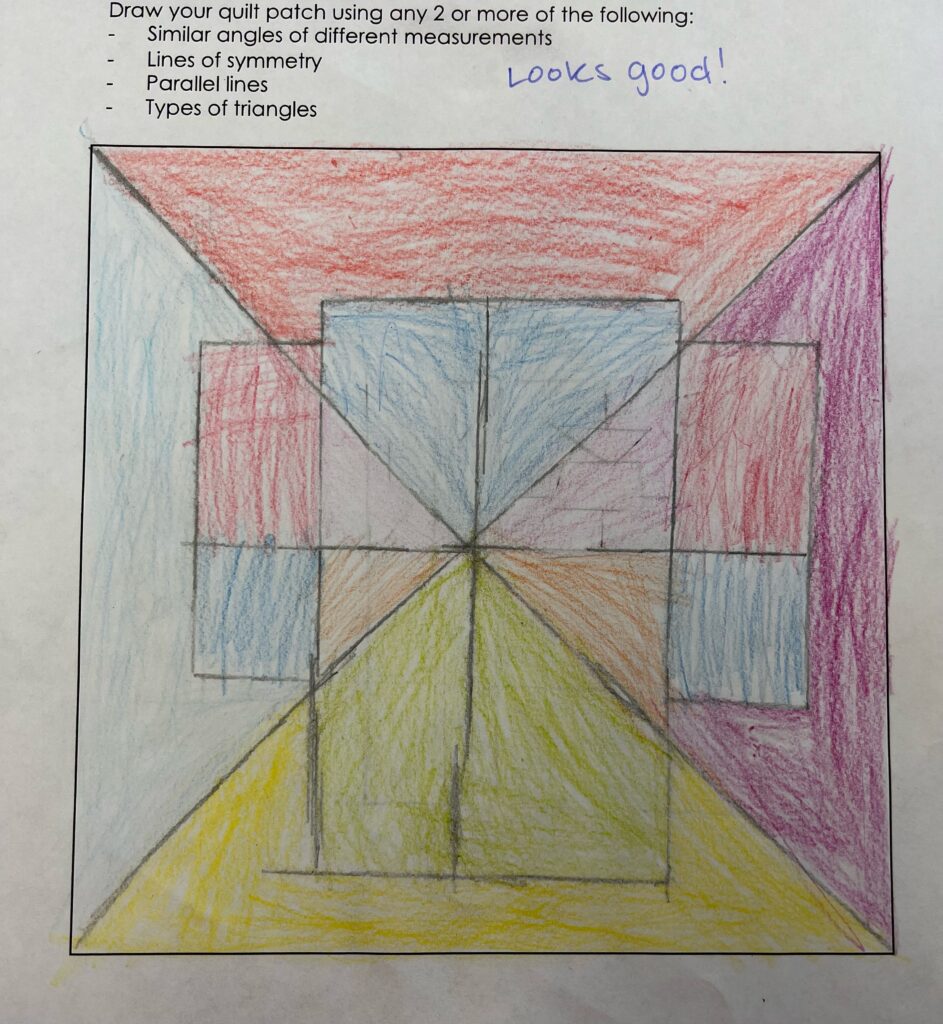
This patch used parallel lines, intersecting lines, right angles, acute angles, near-perfect right angles and bright bold colours! This was the intended purpose of this lesson – however, to add further to it I will ask students to identify and label their angles, on the back or subsequent lined paper.
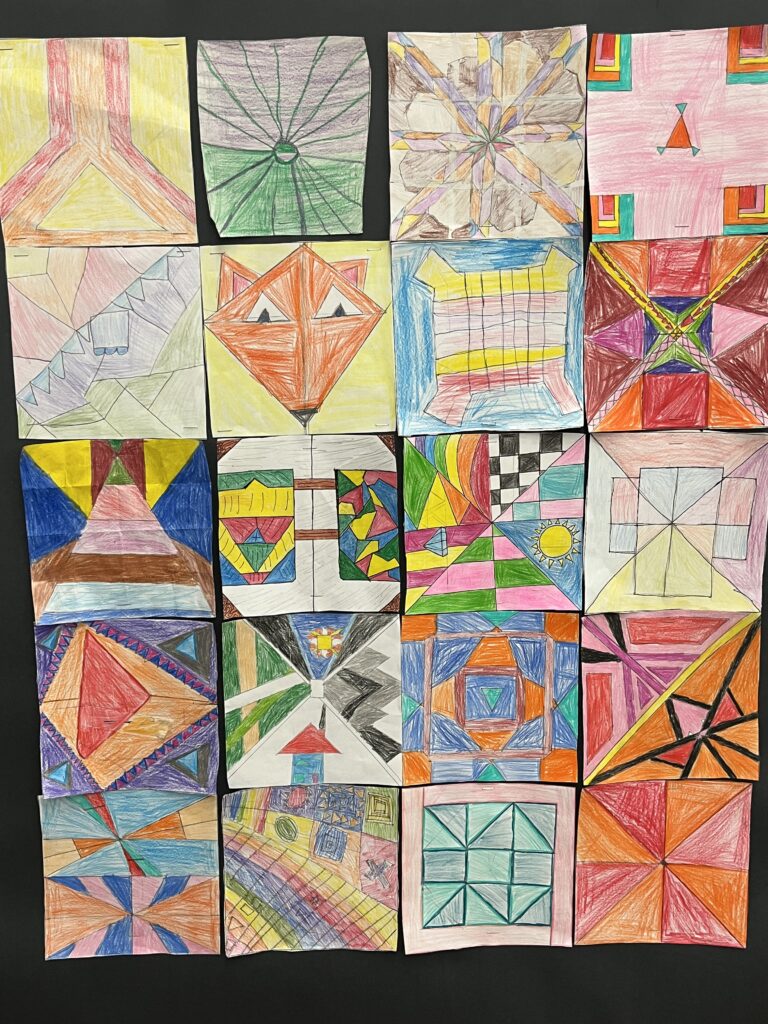
Students shared their work with each other to give peer feedback and work on the similarities and differences between their own and others. We stood in a circle at the back of the classroom and went around each saying something similar they could find between two of the squares – most students found similarities immediately, or could find interesting connections between the patches.

Core Competency: Critical Thinking
Facet: Students engage with others in ways that build and sustain trusting relationships and contribute to collective approaches.
Profile: I express my ideas and help others feel comfortable to share theirs so that all voices are included.
First Peoples Principles of Learning: Learning is holistic, reflexive, reflective, experiential, and relational (focused on connectedness, on reciprocal relationships, and a sense of place).
Big Idea:
- Closed shapes have area and perimeter that can be described, measured, and compared (5)
- Properties of objects and shapes can be described, measured, and compared using volume, area, perimeter, and angles (6)
Curricular Competency:
- Model mathematics in contextualized experiences (5&6)
Content:
- classification: investigating 2D shapes (5)
- angle measurement and classification (6)