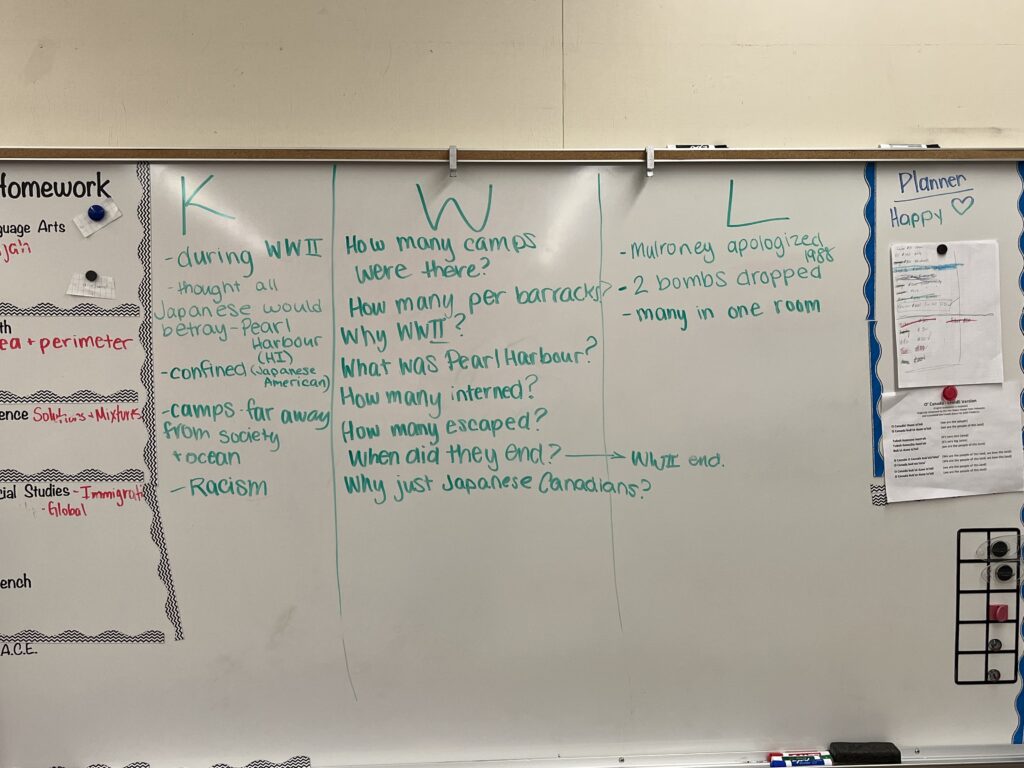
I began teaching the subject of Japanese Internment Camps by creating a KWL chart – this time on the whiteboard.
This activity showed that a KWL chart (for me) is most beneficial when students are given the opportunity to share their opinions and questions without volunteering the information with a teacher-scribe. To explain, I prompted students throughout this activity while the KWL chart that this class created for Residential Schools was self-led.
The interesting part of creating the KWL on the whiteboard was it allowed for further conversation and discussion – but missed many points when writing down thoughts.
This lesson was paired with David Suzuki’s informational video on internment camps, where students were receptive to the language used and discussed the ways that language can be hurtful.
On the following day, students completed the Historical Photo Analysis.
Core Competencies: Critical and Reflective Thinking
Facet: Questioning and investigating
Profile: I can ask open-ended questions, explore, and gather information.
First Peoples Principles of Learning: Learning is holistic, reflexive, reflective, experiential, and relational (focused on connectedness, on reciprocal relationships, and a sense of place).
Big Idea:
- Canada’s policies and treatment of minority peoples have negative and positive legacies (5)
- Systems of government vary in their respect for human rights and freedoms (6)
Curricular Competency:
- Use Social Studies inquiry processes and skills to – ask questions; gather, interpret, and analyze ideas; and communicate findings and decisions (5&6)
Content:
- past discriminatory government policies and actions – internments (5)
- global poverty and inequality issues. including class structure and gender (6)