In a grade 4/5 classroom, where collaboration, discussion, and group work is common, silence is not. I am thrilled that every lesson was loud and when students were on topic. However, this lesson was opposite.
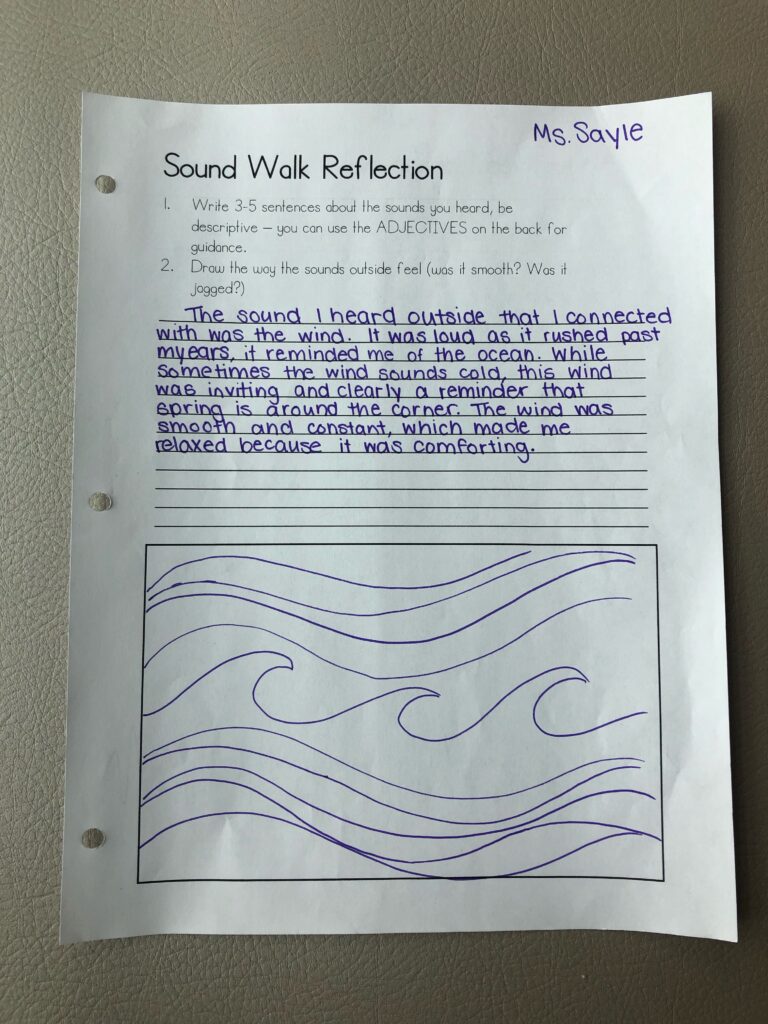
Students were already gathered outside, so we formed a circle, and went over the objective of their time outside – find and focus on a sound, try and think of adjectives that describe that sound, how does it make you feel? Students were given the opportunity to connect with nature, they could close their eyes if comfortable, and listen to the sounds around them.
After 5 minutes, we headed back inside to write reflections on the sounds we heard. This is where students were silent, they were thinking and writing consistently for the remainder of the block. The second part of their “written” work was in the form of depicting their sound through imagery.
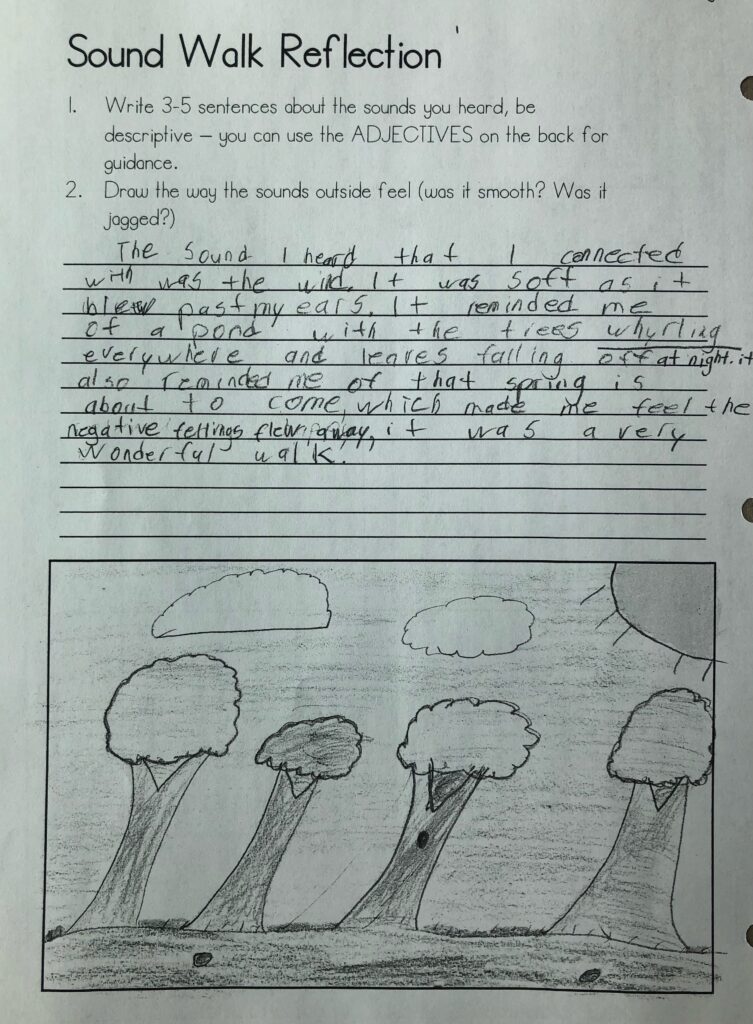

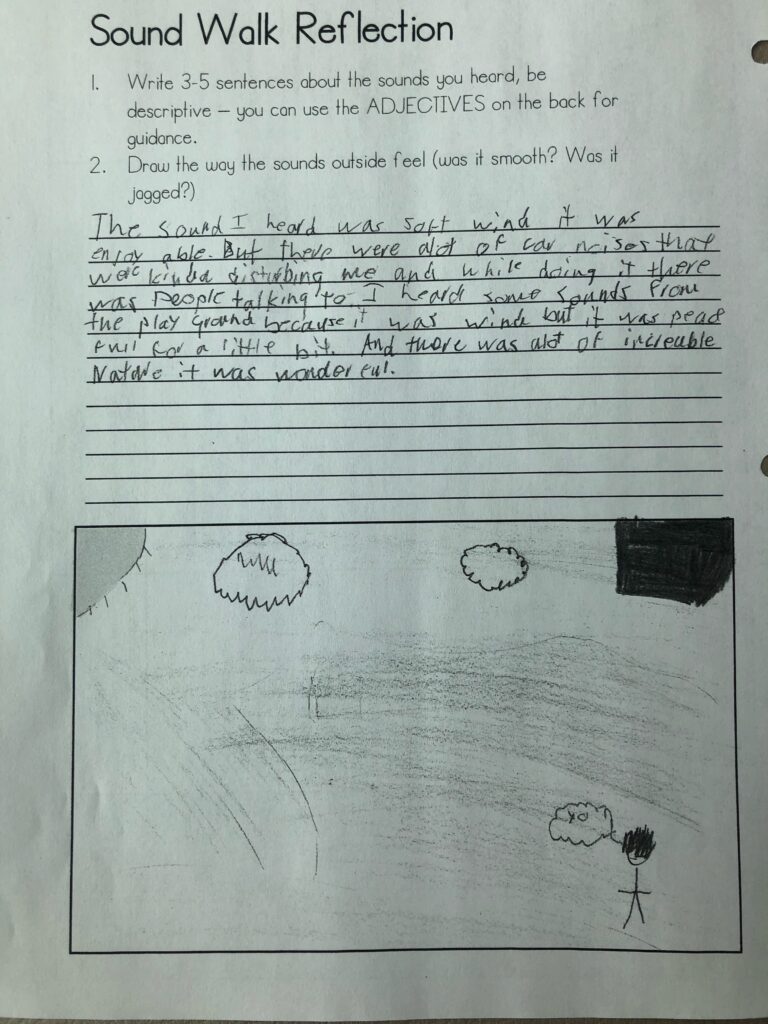
Core Competency: Creative Thinking
Facet: They do this with a sense of place and taking into consideration unintended consequences for other living things and our planet.
Profile: I look for new perspectives, new problems, or new approaches.
First Peoples’ Principles of Learning: Learning is holistic, reflexive, reflective, experiential, and relational (focused on connectedness, on reciprocal relationships, and a sense of place).
Big ideas:
- Using language in creative and playful ways helps us understand how language works (ELA 4/5).
- Creative expression is a means to explore and share one’s identity within a community (Art 4/5)
Curricular Competencies:
- ELA: Communicate in sentences and paragraphs, applying conventions of Canadian spelling, grammar, and punctuation.
- VA: Interpret and communicate ideas using symbolism to express meaning through the arts
Content:
- ELA: Strategies and processes
- VA: symbolism and metaphor create and represent meaning