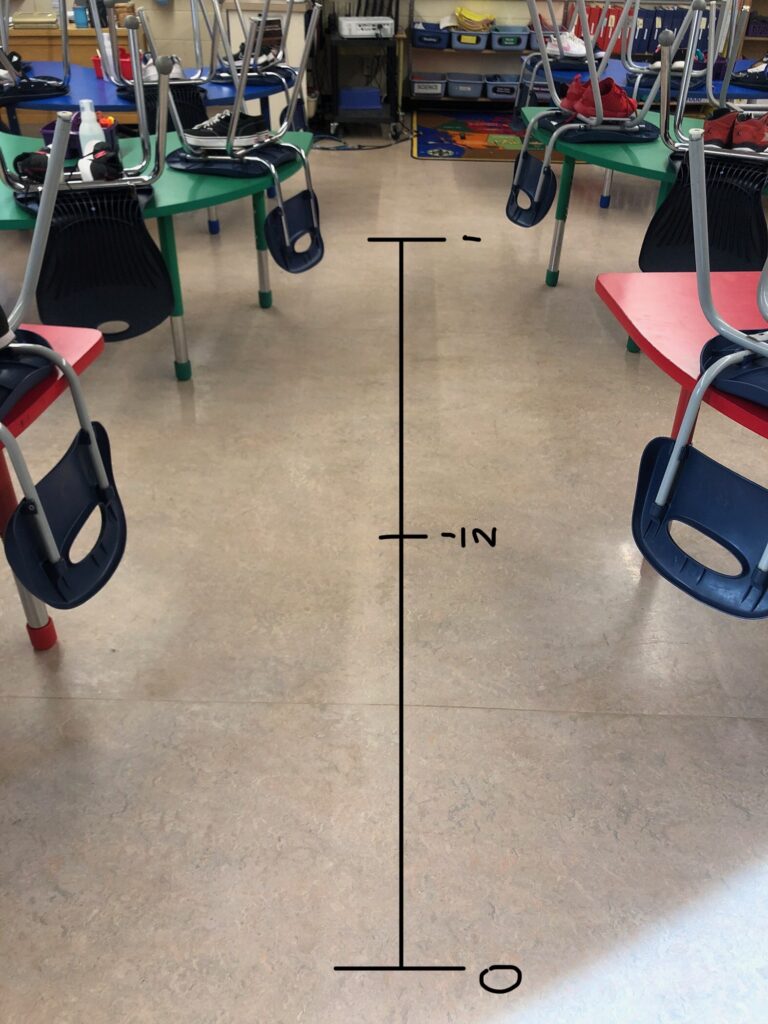
To practice ordering and comparing fractions, I set up a number line down the middle of the classroom. I set one end as 0 and the other as one (as shown below) with a benchmark of 1/2 in the centre, as a start.
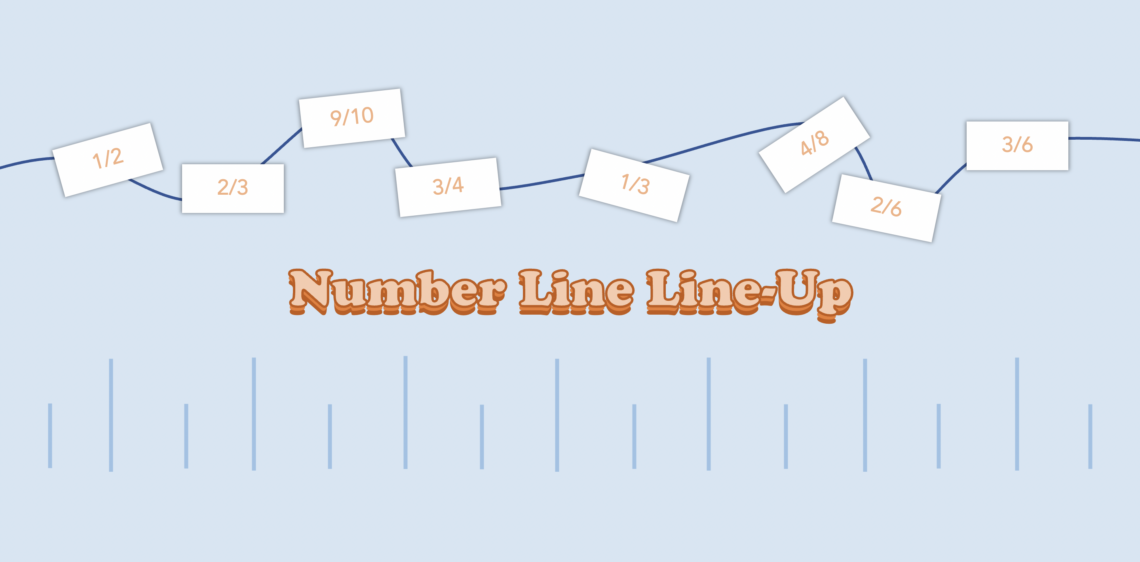
I wrote out benchmark fractions and fractions with the denominators 5, 6, 8, and 10, so that students could make connections about placement initially, and then connecting equivalent fractions. They split into the groups based on denominators, ordered themselves there, and then each group took a stand on the number line, placing their flashcards where they thought they were to go. If subsequent groups saw that the fraction was in the wrong place, they could move it (without making a big deal to embarrass anyone).
This fraction activity focused on understanding fractions, through discussion, collaboration, and learning from mistakes.
Core Competency: Collaborating
Facet: I contribute during group activities with peers and share roles and responsibilities to achieve goals.
Profile: They regulate the group’s interactions together, mutually encouraging one another, creating space for marginalized voices, and applying constructive strategies to navigate through misunderstandings, struggles, and conflict.
First Peoples’ Principles of Learning: Learning involves patience and time.
Big Ideas:
- Fractions and decimals are types of numbers that can represent quantities. (4)
- Numbers describe quantities that can be represented by equivalent fractions. (5)
Curricular Competency:
- Communicate mathematical thinking in many ways (4/5)
Content:
- ordering and comparing fractions (4)
- equivalent fractions (5)